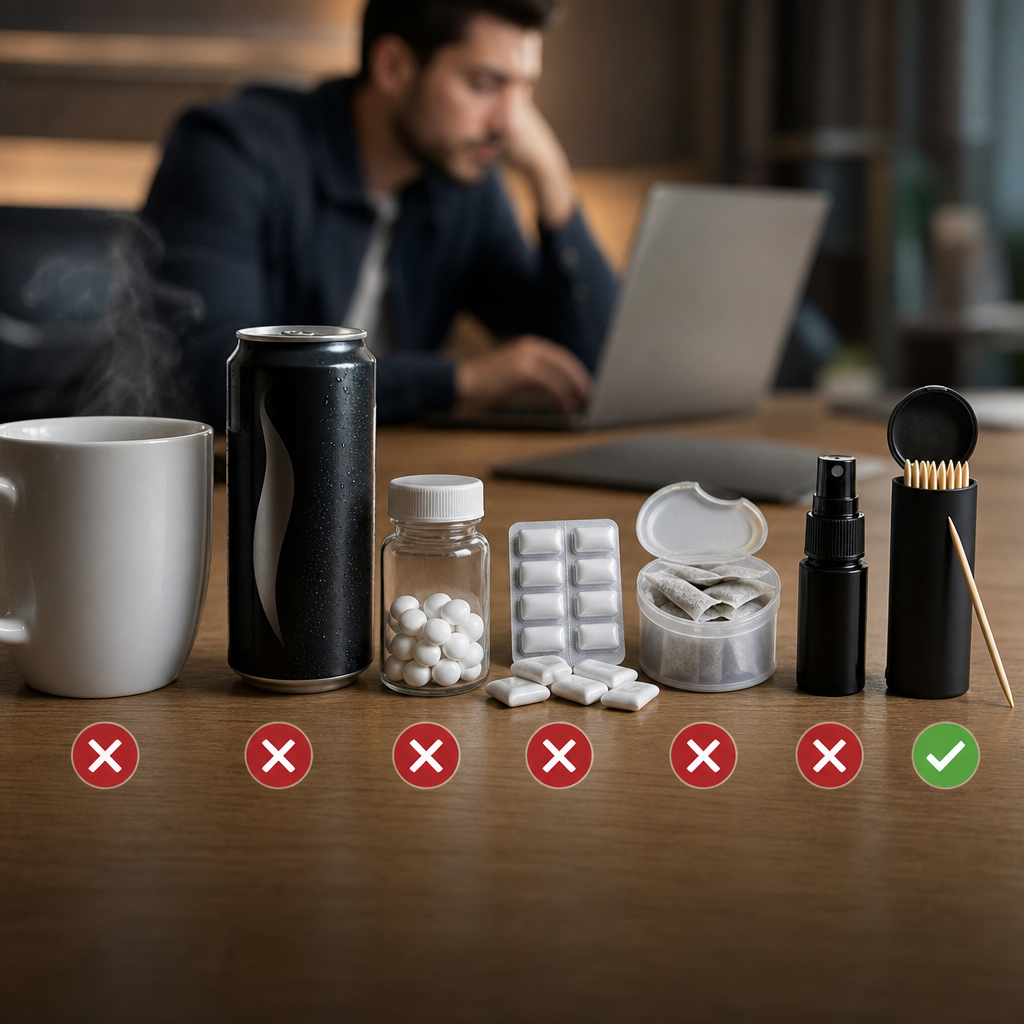



Flavored Toothpicks for Quitting Smoking: How to Use Them
Why Traditional Smoking Cessation Methods Fall Short
Quitting smoking is one of the most difficult habits to break. Most smokers attempt to quit multiple times before it sticks, and the statistics on success rates can feel discouraging. The challenge isn't just physical dependence on nicotine, though that's real. It's the ritual, the hand-to-mouth motion, the oral fixation, and the stress relief you've trained your brain to associate with smoking. Traditional cessation methods address only part of this puzzle, which is why so many people find themselves back at square one.
We created Xero Picks (pronounced ZERO Picks) as a functional alternative that tackles the habits traditional methods miss. Our nicotine-free infused toothpicks deliver long-lasting flavor, B-vitamins for stress support, and the sensory experience your mouth craves, without any of the harmful chemicals. If you've tried patches, gum, or prescription medications and struggled, you might be missing a tool that addresses the behavioral side of your smoking habit.
Looking for something to reach for instead? Shop nicotine-free QUIT toothpicks →
Nicotine replacement therapy and prescription medications work well for some people, but they ignore a fundamental truth: smoking is about much more than nicotine. When you smoke, you're engaging multiple senses and fulfilling a psychological need that goes beyond chemical dependency.
Nicotine patches deliver steady doses of nicotine to curb cravings, but they do nothing for the hand-to-mouth habit, the ritual, or the oral stimulation your mouth expects. Nicotine gum helps with cravings but requires active chewing throughout the day, and many users find the flavor unpleasant or the commitment exhausting. Prescription medications like Chantix can reduce cravings but often come with side effects, and they still leave the behavioral component unaddressed.
The research confirms what many smokers already know: behavioral rituals are as addictive as nicotine itself. A study in Nicotine and Tobacco Research found that smokers who addressed both the chemical and behavioral aspects of smoking had significantly higher quit rates than those who focused on nicotine replacement alone.
Here's the practical gap: traditional methods expect you to simply stop the behavior cold. They don't give your hands and mouth something to do. They don't replicate the sensory feedback smoking provides. This disconnect is why so many people experience intense cravings weeks or months into their quit attempt, even after the nicotine is out of their system.
Our approach is different because we recognize that your mouth needs something to do, and your brain needs a replacement ritual that feels satisfying and functional.
The Hand-to-Mouth Habit: Understanding Your Real Challenge
The hand-to-mouth motion isn't incidental to smoking, it's central to it. This habit has been reinforced thousands of times. Your hands know the motion, your lips know what to expect, and your brain releases dopamine in anticipation of that gesture alone, separate from the nicotine hit.
When you try to quit cold turkey, your hands and mouth rebel. You reach for a cigarette without thinking. Your muscle memory activates. This is why ex-smokers often find themselves reaching for actual cigarettes years after quitting, before their conscious mind catches up.
The psychological reinforcement creates what behavioral scientists call "stimulus cues." Stress triggers the memory of smoking. A social situation reminds you of smoking. Your morning coffee is linked to smoking. These environmental triggers are encoded in your nervous system through repetition.
Oral habits serve multiple functions simultaneously:
- Hand and mouth occupy mental cycles, reducing boredom and anxiety
- The ritual provides a pause and a break from work or stress
- The sensory experience (taste, temperature, texture) is genuinely pleasurable
- The behavior is social in many settings, reinforcing peer bonding
Traditional cessation tools acknowledge the physical habit but not the experiential one. You lose the ritual, the flavor, the mouth engagement, and the hand-to-mouth motion all at once. This shock to your system is why the first few weeks of quitting are so brutal.
We designed Xero Picks to preserve the behavioral elements while removing the harm. You get the hand-to-mouth motion back. Your mouth gets genuine stimulation and long-lasting flavor. Your hands have something satisfying to hold. Your brain recognizes the ritual, even though the content has changed completely.

How Our Nicotine-Free Toothpicks Address Craving Triggers
Our toothpicks use what we call "deep-infusion technology," a patented method that infuses functional ingredients directly into the toothpick itself, rather than coating the surface. This means the flavor and active ingredients are released gradually over 25 to 40 minutes of use, providing sustained relief during high-risk moments.
When a craving hits, you place a Xero Picks toothpick in your mouth. The first thing you notice is a bold, mouth-watering flavor. This isn't subtle, and that's intentional. Your mouth expects strong sensory input from smoking, and a weak mint flavor will feel like settling for less. The flavor intensity tells your brain that you're getting something real and satisfying.
The second sensation you'll experience is a gentle tingle on your lips and tongue. This comes from jambu, a natural extract that stimulates the nerve pathways in your mouth. The tingle activates the sensory experience your mouth craves and increases saliva flow, which freshens your breath naturally. This stimulation is not a bug, it's a feature, and many of our customers report that this activation is what makes the experience feel complete.
The combination of bold flavor, oral stimulation, and the hand-to-mouth ritual addresses the craving at multiple levels:
- Behavioral: You have a hand-to-mouth ritual to replace smoking
- Sensory: Your mouth gets the intense flavor and stimulation it expects
- Functional: B-vitamins and other infused ingredients provide measurable support
- Psychological: The 25 to 40-minute duration gives you a structured window where you're actively managing the craving
When a craving typically hits hard, lasting 5 to 10 minutes without distraction, our toothpick keeps you engaged through the peak window and well beyond. By the time it's done, the acute craving has often passed naturally, and you've successfully replaced the smoking behavior with something that serves your health instead.
The Science Behind Functional Infusions for Stress Relief
Stress is one of the most common relapse triggers for people quitting smoking. When stress spikes, your brain reaches for the coping mechanism it knows works: smoking. Part of smoking's grip is that nicotine actually does reduce stress temporarily by stimulating the release of dopamine and other neurotransmitters. When you quit, you lose that chemical stress management tool, and you need to replace it with something else.
Our Xero Picks infusions include functional ingredients selected specifically to support stress management and mental clarity during high-pressure moments. The B-vitamin complex is the centerpiece of this formula because these vitamins play direct roles in stress response and nervous system function.
Stress relief through infused toothpicks works on several physiological levels. First, the oral stimulation itself activates your parasympathetic nervous system, the branch responsible for the "rest and digest" response. When you activate your mouth's sensory nerves through tingle and flavor, you're literally signaling your nervous system to calm down. This is why chewing gum helps people during stressful presentations, and why our toothpicks have a similar grounding effect.
Second, the ingredients we infuse support your body's natural stress response mechanisms. B vitamins are cofactors in the production of stress-regulating neurotransmitters. When your system is depleted from stress, B-vitamin support helps restore balance. This is why we've made these vitamins a core part of our quit formula.
Third, the mouth-watering effect increases saliva production, which signals to your body that a threat has passed. Dry mouth is actually a stress response, and by stimulating saliva flow, you're sending a physiological signal that you're safe. This creates a genuine feedback loop where the toothpick helps calm your nervous system through multiple pathways simultaneously.
Why B12 and B6 Support Your Quit Journey
When you quit smoking, your body experiences significant metabolic stress. Nicotine has been affecting your neurotransmitter production, your energy metabolism, and your stress response for years. Suddenly removing it creates a deficit that manifests as fatigue, irritability, difficulty concentrating, and increased anxiety. This is why the first two weeks of quitting feel like running on empty.
B vitamins, particularly B12 and B6, address this directly. B12 is essential for energy production at the cellular level and for nervous system function. When your energy bottoms out during your quit attempt, B12 support helps stabilize your baseline so you're not fighting exhaustion on top of everything else. B6 plays a critical role in neurotransmitter synthesis, including serotonin and dopamine, the chemicals that regulate mood and motivation.
Here's the practical difference: when you're fatigued and irritable during week two of quitting, a traditional cessation tool offers no support for how you actually feel. Our B-vitamin infused toothpicks address the metabolic reality of what your body is experiencing.

Research in the journal Nutrients shows that smokers often have lower B-vitamin levels than nonsmokers, both because smoking depletes these vitamins and because smokers tend to have less balanced diets. When you quit, supplementing B vitamins accelerates recovery of normal energy and mood, which directly supports your ability to stay committed to quitting.
The dosing matters too. Our infusions deliver functional amounts of B12 and B6, not homeopathic trace doses. You're getting ingredients at levels that create measurable physiological support. Combined with the behavioral replacement and stress management we've discussed, the B-vitamin support creates a comprehensive approach that works with your body's actual biochemistry during the quit process.
Making the Switch: Your First Week with Xero Picks Quit
The first week quitting smoking is when most relapses happen. Your body is demanding nicotine, your habits feel wrong without a cigarette, and every stress triggers the urge to smoke. Having a concrete strategy for this week makes the difference between success and another failed attempt.
Here's how to use Xero Picks effectively during your first week:
Keep toothpicks everywhere. Your car, your desk, your pocket, your kitchen counter. The moment a craving hits, you should have a toothpick accessible within 30 seconds. If you have to search for one, you'll mentally justify going back to cigarettes instead.
Use one at the first hint of a craving, not only after cravings build. Many smokers try to "tough out" cravings, believing that's a sign of strength. In reality, you're making the craving worse and training your brain to fight through. Use a toothpick as soon as you feel the urge. The goal isn't to eliminate cravings, it's to redirect them.
Commit to 25 to 40 minutes per toothpick. Don't rush through it. This duration is designed to keep you engaged through the peak craving window and well beyond, until the acute urge passes. Use this time to walk, call a friend, work on something, or just sit with the experience. The point is to be active and occupied during this period.
Plan for high-risk moments. If you always smoke with coffee in the morning, plan to use a toothpick then. If you smoke after meals, have a toothpick ready. If stress is your trigger, keep them accessible during workdays. These aren't failures, they're expected moments where you've now planned a replacement behavior.
Expect the tingle and embrace it. The sensation on your lips and tongue is the jambu extract activating your mouth's nerve pathways. It feels different from smoking, and that's correct. Your brain will notice the difference, and that's how it learns that this is a new ritual, not a failed attempt to get the old one back.
The first week sets the pattern. If you successfully redirect cravings with toothpicks during this critical period, you're training your brain to reach for them automatically during week two and beyond.
Real Results: How Our Customers Beat the Habit
We've worked with hundreds of people attempting to quit smoking, and the patterns that emerge are consistent. The people who succeed aren't necessarily the ones with the most willpower. They're the ones who treated quitting as a practical problem to solve, not a battle of resolve.
One customer, Marcus, was a 15-year smoker who had tried patches, gum, and cold turkey multiple times. He kept relapsing around day 10 or 11, when the acute nicotine withdrawal wore off but the behavioral cravings intensified. He switched to Xero Picks and made it through week two for the first time. The difference wasn't that cravings disappeared, it was that having a engaging, long-lasting alternative made the cravings feel manageable rather than overwhelming. Eighteen months later, he's still smoke-free.
Another customer, Jennifer, was a social smoker who found that group settings triggered intense cravings. She used our toothpicks during social events, and the hand-to-mouth ritual felt normal enough that she could participate without feeling like she was missing something. The bold flavor and tingle sensation kept her engaged with the toothpick rather than mentally reaching for cigarettes.
The common thread in successful quits is this: having something that addresses both the behavioral and sensory aspects of smoking, not just the chemical dependence. People succeed when they have a replacement ritual that feels genuinely satisfying, not like deprivation.

Your actionable takeaway: success doesn't require perfection. Some of our customers had one or two cigarettes during their quit attempt and still got back on track the next day. Having a strong alternative to reach for when stress hits or willpower drops makes all the difference.
Building Your Personalized Quit Strategy with Flavored Toothpicks
Every smoker has a different pattern of triggers, stress levels, and behavioral rituals. The most successful quit strategy is one that accounts for your specific life, not a generic approach.
Start by identifying your highest-risk moments. These are the times when cravings are strongest and relapse is most likely. For many people, this is the first cigarette of the day, post-meal cigarettes, stress moments, and social situations. Write these down. These are not weaknesses, they're data points that will guide your strategy.
Next, plan specific toothpick placement and timing for each trigger. If your morning cigarette is the hardest, wake up and use a toothpick immediately with your coffee. If stress is your trigger, keep toothpicks in your desk and car, not just at home. If you're a social smoker, bring toothpicks to events where you'll be tempted.
Consider your flavor preference. Bold flavors work best during active cravings because your mouth expects strong sensory input. Some people rotate flavors throughout the day to keep the experience fresh, while others develop a favorite they rely on. Experiment during your first week to find what feels most satisfying.
Use the Energy Variety 5 Pack or Cool Mint 3 Pack if you want to explore different flavor profiles and see what works best for your quit attempt. Different flavors can serve different moments: an energizing flavor for afternoon slumps, a cooling flavor for stress relief, a bold flavor for intense cravings.
Track your progress by counting cigarettes not smoked, not by the absence of temptation. Cravings will come, even weeks into quitting. The win is having a plan to redirect them. Write down each time you successfully use a toothpick instead of smoking. This builds evidence in your mind that you're capable of making a different choice when cravings hit.
The Long-Term Benefits Beyond Just Quitting Smoking
Quitting smoking isn't a temporary goal with an endpoint. It's the first step toward a healthier life, and the benefits compound over time in ways that go far beyond simply avoiding cigarettes.
Within days of quitting, your sense of taste and smell begin to return. Food tastes better. Coffee tastes like coffee again. This sensory improvement is motivating, though it's also why many people gain weight when they quit. You're suddenly enjoying food more intensely. By using Xero Picks, which are completely sugar-free and calorie-free, you have a mouth-engaging alternative that doesn't create new habit loops around snacking.
Within weeks, your energy improves as your body stops fighting the stress of nicotine exposure. Your lungs start clearing. Your skin improves. Your cardiovascular system begins to recover. These changes might seem gradual, but they're real, and they reinforce why quitting was worth the effort.
Within months, the behavioral cravings diminish. Your brain stops expecting a cigarette with coffee. Social situations no longer trigger the same automatic reach. The neural pathways that associated smoking with stress relief have begun to rewire. You're genuinely changing your brain's response patterns, not just fighting them through willpower.
Long-term, the health benefits are profound. You've eliminated your primary source of preventable disease risk. Your risk of heart disease, stroke, cancer, and COPD drops dramatically. Your family isn't exposed to secondhand smoke. Your finances improve. Your sense of control and self-efficacy strengthens because you've accomplished something genuinely difficult.
Our customers often tell us that the real win isn't just quitting smoking. It's feeling genuinely capable of changing habits they thought were permanent. That capability extends to other areas of life. If you can quit smoking, what else can you change?
Start with a clear first week strategy. Have Xero Picks accessible during your highest-risk moments. Use them immediately when cravings hit, before they build. Commit to 25 to 40 minutes per toothpick and use that time to do something that matters to you. Track your progress by cigarettes not smoked. By week two, you'll have evidence that quitting isn't about willpower alone, it's about having the right tools and a plan that actually works.
Quitting smoking is one of the best decisions you'll make for your health. Make it manageable by addressing both the behavioral and sensory aspects of your smoking habit, not just the chemical dependence. We're here to support that journey with toothpicks designed specifically for people like you.
Shop Xero Picks
- Nicotine-free QUIT toothpicks - B12-infused picks, no nicotine
- Quit Variety 5 Pack - try five flavors first
- What are flavored toothpicks? - how the infusion works
About the author
Todd Rosenbaum is the founder of XERO PICKS®. His work focuses on flavored and infused toothpicks and practical products for everyday routines.