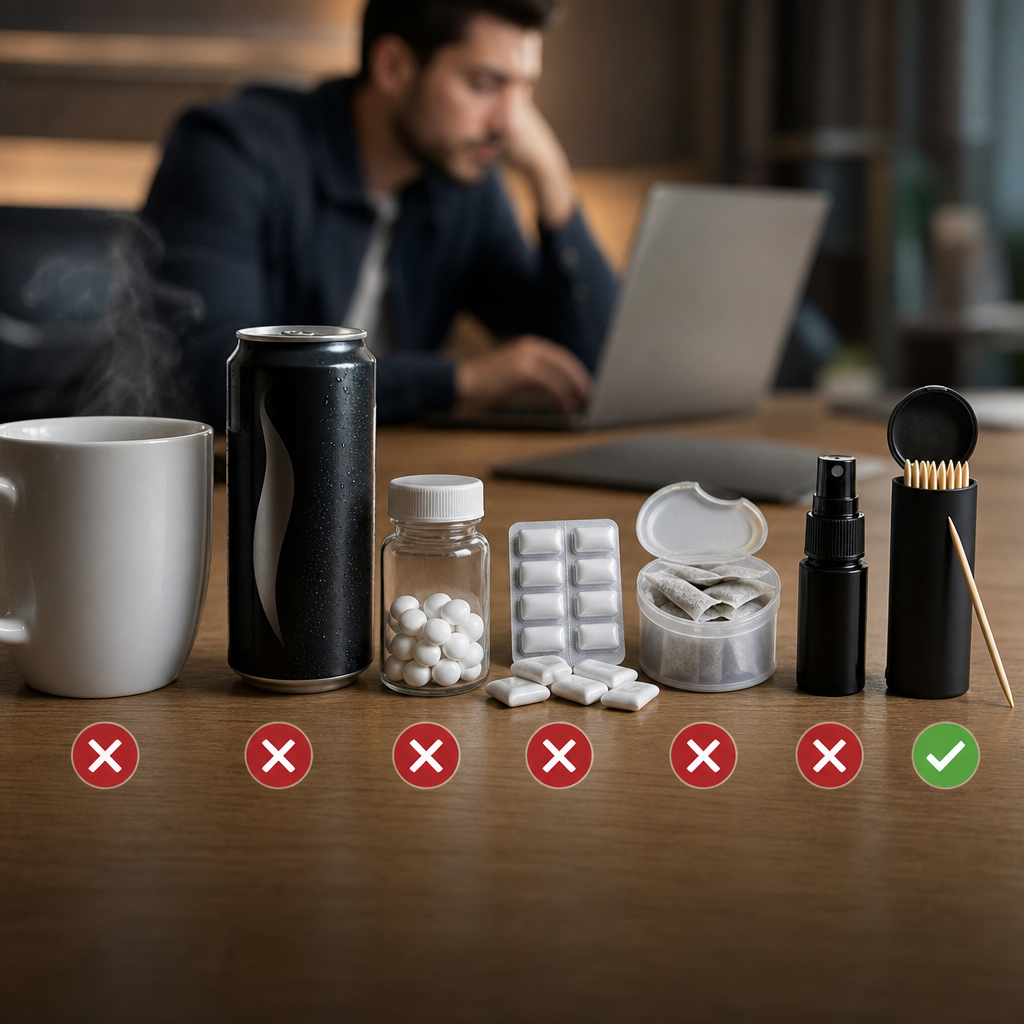


How to Satisfy Hand-to-Mouth Habits Without Nicotine or Vaping
Understanding the Hand-to-Mouth Habit Cycle
Breaking a hand-to-mouth habit is harder than most people expect. Whether you've quit smoking, vaping, or constant snacking, your mouth and hands miss the repetitive motion, the ritual, and the sensory stimulation. Traditional replacement methods often leave you feeling unsatisfied or keep you locked in cycles of dependency on substances you're trying to escape.
We built Xero Picks because we recognized this gap. Our premium, USA-made infused toothpicks deliver functional ingredients directly through oral stimulation, satisfying the behavioral and sensory components of hand-to-mouth habits without nicotine, sugar, or empty calories. This approach works differently than gum, lozenges, or willpower alone because it addresses what your mouth actually craves: sensation, flavor, and a physical ritual to anchor your day.
Let's explore how understanding your habit cycle leads to choosing solutions that actually stick.
Hand-to-mouth habits aren't just about nicotine or sugar. They're nested in three layers: physical dependency, behavioral repetition, and sensory reward.
The physical layer involves your body's chemical cravings. After repeated nicotine or sugar exposure, your brain's reward pathways expect those substances. But the behavioral and sensory layers are often more stubborn. Your hand reaches toward your mouth during stress, boredom, or habit windows throughout the day. Your mouth expects something to happen: a flavor burst, a tingle, a warming or cooling sensation. This multi-sensory expectation is why a simple distraction rarely works long-term.
Consider a typical day for someone quitting smoking. Morning coffee triggers the urge. Mid-afternoon stress at work intensifies it. Evening wind-down reactivates the habit. Each moment isn't just about nicotine; it's about the hand-reach, the oral sensation, the 5-10 minute "break" ritual that punctuated your day.
Understanding this cycle means recognizing that effective replacement must deliver on all three levels: reduce actual chemical cravings, provide a compelling physical behavior, and offer genuine sensory satisfaction. Half-measures leave your mouth and hands restless.
What to do next: Identify your three biggest habit trigger moments this week. Write them down with the context (time of day, activity, emotion). This awareness becomes your roadmap for when replacement solutions need to work hardest.
Why Traditional Quit Methods Fall Short
Nicotine replacement therapy (NRT) like patches and gums addresses the chemical dependency but ignores the behavioral loop. You're still fighting the urge to reach for something, to do something with your hands and mouth. The patch sits silently on your arm while your hands twitch.
Cold turkey approaches rely entirely on willpower, which depletes over time. Research shows willpower is a finite resource. After resisting one craving, your capacity to resist the next one diminishes. By evening, you're exhausted and more vulnerable.
Prescription medications like varenicline (Chantix) reduce cravings at the neurochemical level, but they often come with side effects and don't replace the behavioral ritual. You still have to solve the "what do I do with my hands now" problem.
Oral substitutes like standard gum or hard candies offer distraction but lack functional benefit. Many contain sugar, which triggers its own reward cycle and can lead to new habits. Sugar-free versions often have artificial sweeteners that some people find unsatisfying or physically uncomfortable.
None of these address what we call the "sensory satisfaction gap." Your mouth has developed an expectation: something enters, flavor develops, sensation builds, ritual completes. Without that sequence, even if the chemical craving fades, the behavioral craving persists. You'll find yourself reaching for alternatives that aren't better, just different.
Actionable insight: If you've tried patches, gum, or cold turkey before, write down what was missing. Did you need stronger flavor? A longer-lasting sensation? Something for your hands to do? These gaps point toward what your replacement solution actually needs to deliver.
The Problem With Replacement Options
Many habit-replacement products create new problems while solving the old one.
Nicotine pouches and lozenges deliver nicotine without smoke, but they perpetuate nicotine dependency. You're not breaking the cycle; you're just changing the delivery method. This keeps your brain's reward pathways locked in place, making eventual cessation harder.
Vaping was marketed as a smoking alternative, but it's proven to be its own persistent habit with unique health concerns. The aerosol delivery, the hand-to-mouth motion, the flavoring compounds in the lungs, the ongoing nicotine exposure: these create a parallel habit that's equally difficult to break.
Sugar-loaded candy and mints seem innocent compared to cigarettes, but they introduce caloric load, dental wear, and blood-sugar spikes that undermine your overall wellness goals. You've quit one habit to pick up another that sabotages your health in different ways.
Even well-intentioned substitutes like certain lozenges or herbal products often fail because they lack intensity. If the sensory experience is weak, your brain files the replacement as "not enough." You'll unconsciously seek out something stronger, and before long, you're back to old behaviors or cycling through new ones.
The core problem is that most replacements either maintain dependency (nicotine gum), create new health issues (vaping), or miss the sensory requirement (patches). What's needed is a solution that breaks all three cycles: eliminates the substance dependency, satisfies the behavioral ritual with a distinct, compelling action, and delivers genuine sensory reward that doesn't create new problems.
Next step: List the replacement options you've considered or tried. For each, identify whether it solved the chemical craving, the behavioral ritual, or the sensory need. Most fall short on at least one dimension.
Our Patented Approach to Craving Relief
We developed our patented deep-infusion technology because standard toothpicks and candy coatings don't deliver lasting intensity. Our infused toothpicks use a proprietary process that embeds flavor and functional ingredients throughout the entire stick, not just on the surface.
This matters because surface-only coating washes away quickly, leaving a short burst of flavor followed by disappointment. Our approach means the flavor profile stays strong for 25-40 minutes per use, which aligns with how long a typical smoking or vaping habit actually lasted. You're replacing not just the craving but the actual duration of ritual.
The functional ingredients we chose address multiple need states. For smoking cessation, we focus on oral stimulation and craving support through plant-based compounds that activate sensory pathways without nicotine. For energy or focus support, we include caffeine and B-vitamins that deliver measurable benefits. For dry mouth relief (xerostomia), our toothpicks stimulate saliva production naturally, addressing both the physical and comfort dimensions of this condition.
Our formulation is sugar-free and zero calories, so you're not trading one dependency for another. The tingle sensation you'll experience comes from a natural extract called jambu, which stimulates nerve pathways in your mouth and tongue. This isn't an accident or side effect; it's essential to the design. That tingle activates your sensory system fully, making the experience memorable and satisfying in a way flat flavors cannot.
Everything we make is USA-manufactured. We control quality at every step, which matters when you're putting something in your mouth multiple times daily.
What this means for you: You're getting a replacement that works on the exact timeline of your old habit, with sensory intensity that actually registers, and functional ingredients that support your goals rather than undermine them.
How Xero Picks Quit Satisfies Your Oral Cravings
When you reach for a Quit Smoking Toothpick, you're engaging all three layers of habit satisfaction simultaneously.
Behaviorally, the physical action mirrors what you're replacing. Your hand reaches into a small package, retrieves a stick, places it in your mouth. The motor sequence is familiar, which makes the switch feel natural rather than punishing. You're not white-knuckling through a craving with nothing to do; you're performing the same ritual with a different object.
Sensorily, the experience unfolds over time. You place the toothpick and immediately experience a bold, mouth-watering flavor. The jambu extract creates that tingle sensation on your lips and tongue, which signals to your nervous system that something real is happening. Your mouth waters, saliva increases, and the flavor compounds release progressively. This isn't a quick hit followed by flatness; it's a 25-40 minute experience that occupies the same temporal space as your old habit.
Functionally, the toothpick delivers craving-support ingredients that address the neurochemical gaps left by quitting. Unlike nicotine gum, which maintains dependency, our formulation supports your body's transition away from the substance while still addressing the sensation-seeking components. Your mouth gets the stimulation it expects, but your brain isn't reinforcing the chemical dependency loop.
The key insight here is that satisfaction isn't just about taste. It's about the full sensory and behavioral package. When all three layers are addressed, the replacement feels legitimate rather than like a consolation prize.
Practical action: Use your three trigger moments identified earlier. Plan to have a Xero Picks Quit toothpick at each moment, not as a white-knuckle last resort but as your expected choice. Let yourself experience the full 25-40 minute duration. Notice how the ritual itself becomes satisfying.
Key Ingredients That Support Your Success
Our formulation combines ingredients chosen for functional benefit and sensory intensity.
Jambu (pronounced jahm-boo) is a natural extract that creates the tingle sensation essential to oral satisfaction. It activates sensory nerves without numbing or dulling your mouth, which is important because many numbing lozenges leave your mouth feeling dead and unsatisfying. The tingle means your nervous system is engaged and processing the experience fully.
For quit-smoking formulations, we include plant compounds that support your body's transition away from nicotine dependence. These aren't miracle substances, but they work synergistically with behavioral replacement to ease the neurochemical adjustment period.
Caffeine and B-vitamins appear in our energy and focus formulations, delivering measurable benefits for users seeking functional alternatives to energy drinks or constant snacking. Fifty to 100 mg of caffeine from a toothpick provides the same boost as a strong cup of tea, delivered orally over a sustained period.
All ingredients are selected for purity and efficacy. We avoid artificial sweeteners that some users find unsatisfying. Our formulations use alternative sweetening approaches that complement rather than fight the natural flavor profiles we've developed.
Implementation detail: If you're using our quit products, understand that the functional ingredients support your transition but don't replace nicotine entirely. The real work is behavioral; the ingredients are supporting that work. Use them at your trigger moments, not as an emergency response to a sudden intense craving.
Making the Switch: Your Transition Strategy
Quitting cold turkey while also eliminating your coping mechanism is a difficult combination. A gradual transition often works better.
Week one, identify your three biggest trigger moments without changing behavior. Just become aware. When does the hand-to-mouth urge hit hardest? Morning? Afternoon stress? Evening wind-down?
Week two, introduce our toothpick at one of those moments. Don't eliminate your old habit yet; just add the new one alongside it. Let your mouth and brain become familiar with the new sensation. The goal is neural recognition: "When I'm stressed at 3 PM, this new ritual is available and satisfying."
Week three, you'll likely notice that the old habit feels redundant. Your mouth is getting the stimulation it needs from the replacement. This is the moment to consciously eliminate the old behavior at that trigger point. Replace, don't eliminate. This psychological distinction matters because it avoids the scarcity and resentment that comes from pure deprivation.
Continue this pattern for your remaining triggers over the following weeks. By staggering the transition, you're building new neural pathways gradually rather than asking your brain to rewire everything simultaneously.
Keep your toothpicks accessible. Don't hide them in a drawer where you have to work to find them; keep them where the old habit products used to live. Environmental cues matter. If cigarettes used to sit on your desk, that's where your toothpick container should be.
Track your use honestly. Don't aim for zero toothpicks; aim for using them at intentional moments rather than unconsciously. If you're using 15 per day instead of 20 cigarettes, that's success. The metric is replacement, not abstinence from all oral habits.
Concrete step: This week, choose your single biggest trigger moment. Get a package of Xero Picks Quit. Use it at that moment daily for seven days. Journal how it feels compared to your old habit. By day seven, you should feel noticeably more satisfied with the replacement than you would with returning to the original.
Real Benefits Beyond Just Satisfaction
The benefits extend past the moment of use.
Oral health improves because you're not exposing your mouth to smoke, tar, or constant sugar exposure. The stimulation from our toothpicks actually increases saliva production, which protects teeth and gums. Learn more about this in our science of saliva stimulation.
Breath freshness follows naturally. The mouth-watering flavor and increased saliva flow counteract the staleness that lingers after smoking or that comes from dry mouth. Many users report noticeably fresher breath within the first week of switching.
Cost savings accumulate quickly. A pack of cigarettes runs $7-15 depending on location. A day's worth of toothpicks costs a fraction of that. Over a month or year, the financial difference is substantial.
Energy and focus improve if you're using our energy-supportive formulations, and they improve further from the simple fact that your sleep quality often gets better once smoking or vaping stops disrupting your nervous system.
Psychological wins build momentum. Each successful trigger moment where you choose the replacement builds confidence. You're literally proving to yourself that you can reshape your behavior. This confidence carries into other areas of life where you want to improve.
The sensory pleasure remains real. This isn't about white-knuckling through an unpleasant transition; you actually enjoy the experience of using Xero Picks. Pleasure and progress aren't contradictory in this context.
Measurement task: After your first week of using our toothpicks at your chosen trigger moment, note three specific improvements: one related to physical sensation (breath, mouth feeling), one related to behavior (ease of the transition), and one related to outcomes (cost saved, or another metric that matters to you). Concrete evidence of benefit reinforces commitment.
Integrating Our Solution Into Your Daily Routine
Make the toothpick part of your environment and schedule, not an add-on you have to remember.
Morning routine: Place a toothpick in your coffee mug area or near your breakfast. If morning coffee was a trigger, this contextual placement signals the new ritual.
Work stress moments: Keep a small container on your desk or in your bag. When afternoon stress hits, reaching for a toothpick becomes as automatic as the old behavior was.
Evening wind-down: If your evening used to involve your old habit, make our toothpick part of that same time. Sit in the same place, but with a toothpick instead. The context remains; the substance changes.
Social situations: This is where habit substitution often breaks down. You're in a situation where your old habit was social (smoking breaks, passing around vapes). Have a toothpick ready to use instead. The hand-to-mouth motion will feel familiar to you even if it looks different to others.
Post-meal moments: Many users found their old habit tied to eating. Finish a meal, reach for a toothpick instead. The flavor freshens your mouth, increases saliva, and gives your hands something to do while conversation continues.
Don't overthink it. You're not scheduling "toothpick time" as a separate activity. You're replacing the object in habits you already perform daily. The ritual framework is already there; the toothpick just fills it better than what came before.
Design your own trigger placement: Map three places in your physical environment where you'll keep toothpicks visible and accessible. Not hidden as emergency supplies, but present as your expected choice at those moments.
The Long-Term Advantage of Choosing Functional Alternatives
Most habit-breaking strategies are designed to be temporary. You quit smoking, and after six months or a year, you're supposed to no longer need replacement at all. This works for some people, but many find that once they've broken the chemical dependency, the behavioral and sensory habit persists indefinitely.
With Xero Picks, we've designed something that works as a long-term substitute rather than a temporary bridge. The toothpick isn't something you'll grow out of or resent. The flavor is genuinely enjoyable. The functional ingredients deliver real benefits. The ritual is satisfying without being destructive.
This matters psychologically and practically. You're not fighting toward a future where you want nothing; you're building toward a future where your oral habit delivers genuine value instead of harm.
Over time, you may find yourself using fewer toothpicks than you initially did. As the behavioral component weakens, the sensory and functional reasons for use remain. You might use 5-8 toothpicks daily instead of your original 20 cigarettes, and each one serves a purpose: stress relief, energy, focus, fresh breath, or simple pleasure.
The long-term advantage is that you're never building resentment toward the replacement because it's not denying you something you want; it's giving you something better. You're not waiting to be free of the habit; you're enjoying the transition itself.
Your health metrics improve across multiple dimensions: cardiovascular, respiratory, oral, and financial. Your confidence in your ability to reshape behavior carries into other life areas. You've proven to yourself that lasting change is possible when you address all three layers of habit simultaneously.
The choice, then, isn't between your old habit and deprivation. It's between continuing a destructive pattern and choosing a solution that satisfies your needs while serving your health. That's a choice you can feel good about making every single day.
Your next move: If hand-to-mouth habits have held you back, start with your single biggest trigger moment. Use our toothpicks intentionally at that moment for two weeks. Track how the replacement feels compared to what came before. Let the sensory experience and functional benefits speak for themselves. Most people find that within two weeks, the new ritual feels legitimate and satisfying, which is when momentum builds toward lasting change. Visit our Quit Smoking Toothpicks collection to explore options tailored to craving support, and remember that choosing functional alternatives isn't settling; it's upgrading.
Shop Xero Picks
- Nicotine-free QUIT toothpicks - B12-infused picks, no nicotine
- Quit Variety 5 Pack - try five flavors first
- What are flavored toothpicks? - how the infusion works
About the author
Todd Rosenbaum is the founder of XERO PICKS®. His work focuses on flavored and infused toothpicks and practical products for everyday routines.